

The Work Moves Forward—Because It Must

Let’s focus on the problems and solutions- Not the spectacles.
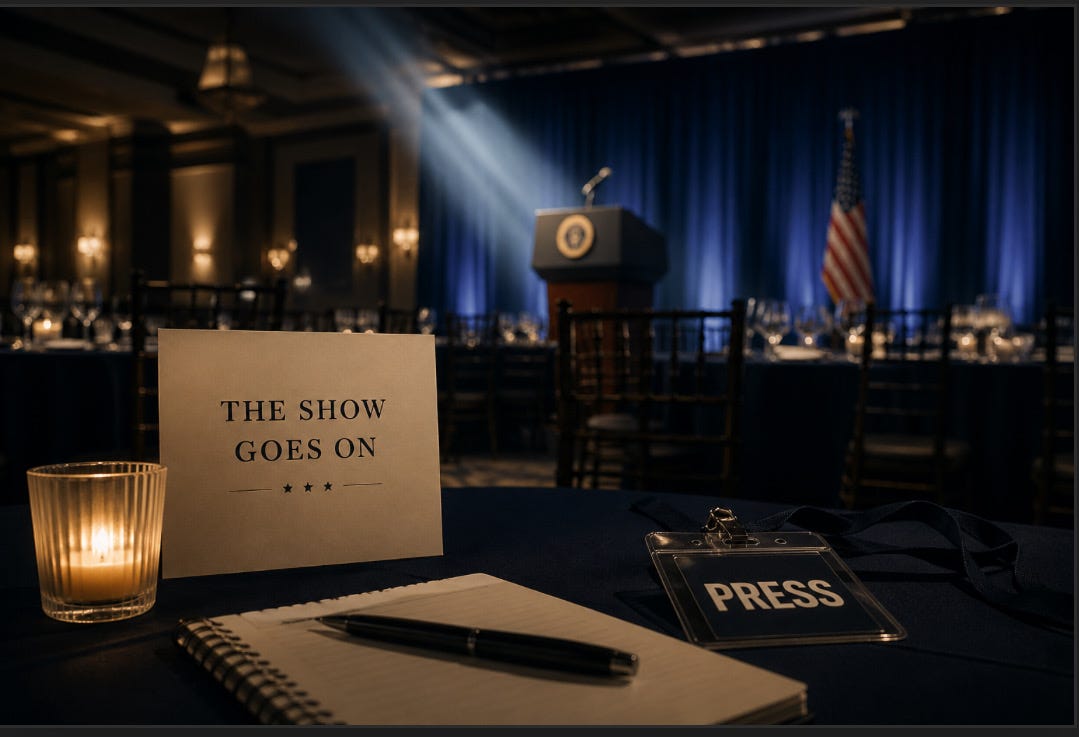
Lights positioned with intent. A podium centered for clarity. Rows aligned not just for seating, but for sightlines—for narrative. Events like these are not accidents of staging. They are systems. Built to hold attention. Built to deliver message. Built to continue.
And they do.
Even when something breaks outside the frame.
Public life, especially at the level of political ceremony and media access, is structured around resilience of appearance. The schedule holds. The remarks proceed. The camera angle remains steady. This is not indifference. It is design. Institutions, particularly democratic ones, rely on visible stability as a signal to the public that order persists (Blair & Schweit, 2014; U.S. Secret Service, 2019).
But that stability has a cost.
When violence intersects with public space—whether at a civic gathering, a media event, or in proximity to them—the immediate question is not only what happened, but how it is absorbed. Research on mass violence consistently shows that such incidents are not isolated disruptions; they are moments that test the capacity of systems to respond, communicate, and maintain trust (Federal Bureau of Investigation [FBI], 2023).
What is known, in the early hours after any incident, is often limited. Law enforcement works to establish identity, motive, access, and method. Those answers do not come quickly. They should not. Accuracy takes time. Premature certainty has its own consequences.
What fills that gap, however, is attention.
And attention is not neutral.

Media coverage plays a critical role in shaping public understanding of violence, but it also carries risk. Studies have shown that repeated, high-intensity coverage of violent events can amplify fear beyond statistical reality and, in some cases, contribute to imitation effects among individuals seeking notoriety (Meindl & Ivy, 2017; Schildkraut & Elsass, 2016). This is why many outlets have begun to limit the use of perpetrators’ names and images, shifting focus toward victims, responders, and verified facts.
That shift matters.
Because the story is not the individual who chose violence.
It is the impact.
It is the people injured, the families disrupted, the responders moving toward uncertainty while others move away. It is also the systems—medical, investigative, legal—that must function precisely when conditions are least stable. In high-risk environments, coordinated response and clear communication are the difference between contained harm and cascading failure (U.S. Secret Service, 2019).
And still, the event continues.
Not because nothing happened, but because something did—and stopping entirely is not always an option. Public institutions cannot simply pause indefinitely. There are decisions to make, information to deliver, responsibilities that extend beyond a single moment. The continuation is not a dismissal of harm; it is an assertion that disruption will not dictate the whole.
But it should never erase the part.
There is a line that must be held—between continuity and acknowledgment. Between message and reality. Between what is presented and what is lived.
The room, with its lighting and symmetry, will always suggest control. That is its purpose. But just beyond it, there are always variables—people, decisions, actions—that resist neat framing. The work, for those reporting and those leading, is to keep both in view at once.
To tell the truth of what is known.
To say clearly what is not.
To refuse to elevate violence into spectacle.
And to ensure that, even as the show goes on, the story does not lose its center.
That center is not the stage.
It is the people.
Anyone affected by violence deserves more than a headline. They deserve care, recovery, and the full attention of the systems built to protect them. That remains the only outcome that matters.
References
Blair, J. P., & Schweit, K. W. (2014). A study of active shooter incidents, 2000–2013. Texas State University and Federal Bureau of Investigation. https://www.fbi.gov/file-repository/active-shooter-study-2000-2013-1.pdf
Federal Bureau of Investigation. (2023). Active shooter incidents in the United States in 2022. U.S. Department of Justice. https://www.fbi.gov/file-repository/active-shooter-incidents-in-the-us-2022-042623.pdf
Meindl, J. N., & Ivy, J. W. (2017). Mass shootings: The role of the media in promoting generalized imitation. American Journal of Public Health, 107(3), 368–370. https://doi.org/10.2105/AJPH.2016.303611
Schildkraut, J., & Elsass, H. J. (2016). Mass shootings: Media, myths, and realities. Praeger.
U.S. Secret Service. (2019). Mass attacks in public spaces: 2019 report. National Threat Assessment Center. https://www.secretservice.gov/sites/default/files/reports/2020-04/Mass_Attacks_in_Public_Spaces_2019.pdf